
Account Based Marketing Market Size, Share, Trends, Growth and Forecast 2034

Account Based Marketing Market By Account Type (Strategic account-based Marketing, Programmatic Account-based Marketing and Account-based Marketing Lite), By Organization Size (Small and Medium Enterprises (SMEs) and Large Enterprises), By End-use (Media, Telecommunications, and IT, Retail & E-commerce, BFSI, Automotive and Manufacturing, Healthcare and Life Sciences, Government and Public Sector and Others) and By Region - Global and Regional Industry Overview, Market Intelligence, Comprehensive Analysis, Historical Data, and Forecasts 2025 - 2034
| Market Size in 2024 | Market Forecast in 2034 | CAGR (in %) | Base Year |
|---|---|---|---|
| USD 1.42 Billion | USD 7.31 Billion | 17.8% | 2024 |
Account Based Marketing Industry Perspective:
What will be the size of the global account based marketing market during the forecast period?
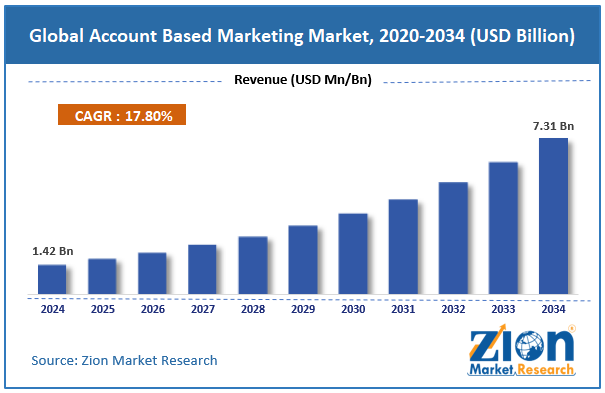
The global account based marketing market size was worth around USD 1.42 billion in 2024 and is predicted to grow to around USD 7.31 billion by 2034 with a compound annual growth rate (CAGR) of roughly 17.8% between 2025 and 2034.
Key Insights
- As per the analysis shared by our research analyst, the global account based marketing market is estimated to grow annually at a CAGR of around 17.8% over the forecast period (2025-2034).
- In terms of revenue, the global account based marketing market size was valued at around USD 1.42 billion in 2024 and is projected to reach USD 7.31 billion by 2034.
- Increasing adoption of AI and predictive analytics is expected to propel the account based marketing market over the projected period.
- Based on the account type, the strategic account-based marketing segment captures the largest market share in 2024 of 48%.
- Based on the organization size, the large enterprises segment holds the largest market share over the projected period.
- Based on the end-use, the BFSI segment holds a prominent revenue share in 2024.
- Based on region, North America captures the largest market share in 2024 of 33%.
Account Based Marketing Market: Overview
Account based marketing is a highly targeted business-to-business (B2B) marketing strategy in which organizations focus their sales and marketing efforts on specific high-value accounts. In the ABM strategy, a company identifies the top-performing organizations or decision-makers who have the potential to generate considerable revenue for the organization. They craft tailored marketing programs and implement personalized initiatives to meet the requirements of target accounts. Such marketing strategies help acquire new customers, nurture relationships, drive conversions, and increase ROI. Account-based marketing solutions leverage technologies such as CRM, AI, predictive analytics, and intent data to deliver personalized experiences via email, social media, webinars, online ads, and other platforms. ABM is popular across a variety of industries, including IT, healthcare, manufacturing, finance, and telecom.
Impact of the USA-Israel War on Iran on the Account Based Marketing Market
The continuation of the battle between the USA, Israel, and Iran has resulted in several indirect consequences for the account based marketing market, including business confidence levels, investment in new technologies, security measures, and budgets allocated to enterprise marketing efforts. Geopolitical unrest, supply chain difficulties, inflation, and rising energy prices have contributed to uncertainty in the business activities of many corporations, resulting in delays in investing in modern marketing solutions. There have been numerous reports suggesting that the current tension between the states has increased corporate costs and reduced expectations for economic growth across different geographic areas.
Enterprise IT and software development spending was affected by the geopolitical situation; as a result, the account based marketing market will feel the impact, as its solutions rely on modern technological advancements. IDC predicts that geopolitical tensions could lead to a reduction in global IT spending and in enterprise confidence, especially in the Middle East.
Account Based Marketing Market: Dynamics
Growth Drivers
Why does the rising demand for personalized b2b marketing drive the account based marketing market?
One significant factor driving the ABM market is the increasing popularity of customized B2B marketing. Companies realize they need to adopt customized marketing strategies to target and retain high-value enterprise customers. Purchases in the B2B segment are often complex, involve many parties, and have long sales cycles. For these reasons, businesses are looking for ways to adopt personalized engagement techniques tailored to the unique needs, concerns, and aspirations of the various accounts they deal with. ABM technologies can provide personalized communication, customized advertisements, account-specific content, and email campaigns that lead to improved customer engagement.
Moreover, adopting a personalized approach in B2B marketing will help companies increase conversion rates and optimize ROI from their marketing efforts. The adoption of a personalized approach will also ensure that marketing budgets are spent exclusively on prospects who are more likely to become valuable customers. Through technologies such as AI, CRM, intent data, and predictive analytics, ABM platforms can detect customer purchase behavior and provide a customized experience. Such efforts will lead to increased sales and improved customer satisfaction.
Furthermore, the rise of customer-centric marketing in modern-day enterprises means that companies are expected to provide personalized experiences even in the B2B segment. Decision-makers prefer service providers who know their industry, operational challenges, and future ambitions. Personalized marketing strategies such as email campaigns, LinkedIn advertising, digital advertising, webinars, and personalized website pages can be developed for various channels using ABM platforms. The increasing importance of customer-centric marketing is pushing companies across sectors such as healthcare, manufacturing, telecommunications, information technology, and financial services to adopt ABM platforms.
Restraints
High implementation and operational costs hinder the growth of the account based marketing industry
The high cost of implementing and operating ABM solutions is one of the key factors restraining the development of the ABM market, as ABM requires substantial financial, technological, and human capital. Businesses that have opted to implement the ABM strategy may find themselves in need of purchasing various software solutions, such as customer relationship management (CRM), marketing automation tools, artificial intelligence solutions, predictive analytics solutions, intent-data solutions, and account intelligence solutions. Integration of these solutions into the company's internal processes can be costly and time-consuming.
Apart from the technological aspect of the issue, implementing the ABM strategy requires spending considerable money on creating personalized and customized content, managing data, optimizing campaigns, and coordinating sales and marketing departments. In order to succeed in ABM-related initiatives, it is necessary to create an up-to-date database of potential buyers, keep track of their activities and behaviors, and develop a proper targeting strategy. It might also be necessary to hire a professional with the relevant background and knowledge in data analysis, digital marketing, and account-based strategy development, which would lead to even higher costs.
Another point is that, due to its high-cost structure, ABM might not be an attractive choice for companies with smaller marketing budgets and operating in developing regions. Implementing ABM takes longer than traditional marketing methods, making it hard to convince a budget-conscious company to switch from the former to the latter.
Opportunities
Why does the growth of multi-channel engagement strategies offer a lucrative opportunity for the account based marketing market?
The rising adoption of multi-channel engagement strategies will create a profitable opportunity for ABM, as contemporary buyers prefer engaging with brands through multiple digital and physical channels. Today's business decision-makers use numerous channels, such as emails, LinkedIn messages, webinars, company websites, virtual conferences, digital advertising, apps, and social networks to research products or interact with sellers. Thus, companies are interested in solutions that enable the delivery of personalized, account-based, and coordinated experiences to potential customers across all channels. Account-based marketing platforms enable integrating customer data and communication strategies into a single solution to deliver personalized, timely marketing activities to target accounts across all available channels.
Therefore, personalizing multichannel strategies improves the buyer experience, promotes brand visibility, and increases the likelihood of closing a deal by reaching key decision-makers of potential clients throughout the entire purchasing journey. Moreover, the growing popularity of working from home, remote selling, and digital transformation has accelerated the need for comprehensive multi-channel B2B marketing campaigns. Companies tend to invest more in cloud solutions for account-based marketing, powered by artificial intelligence (AI), predictive analytics, and automated marketing tools to handle customer engagements effectively.
In addition, multi-channel marketing helps companies establish a long-term partnership with customers by enabling tracking of customer behavior across channels and monitoring their satisfaction levels. In particular, long sales and contract periods observed in the information technology, healthcare, manufacturing, financial services, and telecommunications industries contribute to the adoption of multi-channel engagement strategies in marketing. Hence, owing to rising investment in customer-centric, data-driven marketing practices, multi-channel engagement strategies are gaining momentum among enterprises, likely to drive market growth.
Challenges
Why does the complexity of data integration pose a significant challenge to the account based marketing market?
One of the most critical obstacles to account based marketing is the complexity of data integration. As the term suggests, the successful implementation of an ABM strategy hinges on obtaining, combining, and evaluating large amounts of customer and account data. Organizations usually use a variety of data systems, including CRM applications, marketing automation software, ERP systems, website and social media channel analytics, intent data providers, and customer support databases. Data integration to create an effective account perspective is technically complicated and expensive.
Moreover, many businesses operate in a dispersed, siloed environment, where customer data is scattered across separate divisions and applications. Such data inconsistencies include duplicate records, incomplete customer profiles, outdated information, and ineffective targeting. As personalization is a key component of any ABM approach, ineffective data management may negatively impact its implementation. The matter is even more complicated when organizations run large-scale global operations, manufacture multiple products, and have vast client portfolios. To deliver real-time analytics on consumer behavior and purchase intent, organizations need sophisticated systems that can handle and interpret data in real time. The problem becomes even more acute when companies integrate a variety of legacy solutions alongside their modern cloud counterparts.
Another issue that can add extra complexity is the need to comply with relevant privacy regulations, such as GDPR, or other data security laws. Data integration entails proper data handling and sharing across departments, which can be quite challenging. It involves strict governance and customer consent management procedures that may cause additional expenses. All these factors significantly affect the adoption rate of ABM solutions by complicating and costing the entire process. Thus, this challenge might become a key obstacle to the development of the account based marketing market.
Account Based Marketing Market: Report Scope
| Report Attributes | Report Details |
|---|---|
| Report Name | Account Based Marketing Market |
| Market Size in 2024 | USD 1.42 Billion |
| Market Forecast in 2034 | USD 7.31 Billion |
| Growth Rate | CAGR of 17.8% |
| Number of Pages | 226 |
| Key Companies Covered | Terminus Software Inc., Uberflip, Adobe Inc. (Marketo), 6sense Insights Inc., Triblio Inc., Engagio Inc., HubSpot Inc., Madison Logic, Demandbase Inc., Salespanel, Drift.com Inc., RollWorks (NextRoll Inc.), Insider Inc., Folloze, MRP Prelytix (MRP), Kwanzoo Inc., Lattice Engines, TechTarget Inc., Bombora, LeanData, and others. |
| Segments Covered | By Account Type, By Organization Size, By End-use, and By Region |
| Regions Covered | North America, Europe, Asia Pacific (APAC), Latin America, Middle East, and Africa (MEA) |
| Base Year | 2024 |
| Historical Year | 2019 to 2023 |
| Forecast Year | 2025 - 2034 |
| Customization Scope | Avail customized purchase options to meet your exact research needs. Request For Customization |
Account Based Marketing Market: Segmentation
Account Type Insights
Why does the strategic account-based marketing dominate the account based marketing market?
The strategic account-based marketing segment captures the largest market share in 2024 of 48%. The use of strategic ABM is becoming more common when co-created content is used to build trust and develop relationships with strategic clients. Webinars, whitepapers, and custom workshops created by collaborating with the client serve as examples of co-created content. By using these contents, one can showcase their knowledge of the business and present their company as a partner for years to come. Using custom content enables differentiators from competitors in the complex sales process of enterprise sales cycles.
Organization Size Insights
How does the large enterprises segment capture the largest market share in the account based marketing market?
The large enterprises segment holds the largest market share over the projected period. In today’s larger corporations, the use of intent data isn’t limited to the marketing team; sales, product, and customer success teams are also leveraging it. By aggregating behavioral cues from the entire web, businesses can track decision-makers across various stages of their purchasing journey. With such insights in place, the entire organization can coordinate efforts to reach potential customers in a data-driven way, making ABM a strategy adopted at the enterprise level. Teams can make precise campaign adjustments, improve sales cycles and close deals faster than ever before.
End-use Insights
Does the BFSI segment capture the largest market share in the account based marketing market?
The BFSI segment holds a prominent revenue share in 2024. The increasing adoption of ABM by BFSI companies is mainly driven by the need to create highly personalized experiences for high-net-worth individuals and corporations. Programmatic ABM enables highly personalized marketing initiatives, as financial companies can customize their marketing messages and content across digital channels based on customers' behavioral and firmographic attributes. Such personalization is critical in targeting specific accounts with offers such as wealth management services, loans, and business insurance. Programmatic platforms enable the customization of these experiences, driving higher conversion rates and improving client satisfaction.
Regional Insights
Why does North America lead the account based marketing market?
North America captures the largest market share in 2024 of 33%. Growth in this region is driven by rapid adoption and use of advanced digital marketing technologies, the presence of leading B2B firms, and an ever-growing need for more personalized customer interaction. The region, especially the United States, features highly sophisticated technology infrastructure, where technologies such as CRM software, AI solutions, cloud computing, predictive analytics, and marketing automation are widely used, enabling companies to implement ABM successfully. Businesses across industries such as information technology, healthcare, financial services, manufacturing, and telecommunications are investing heavily in ABM solutions to improve lead quality, enhance sales and marketing collaboration, and increase ROI.
Furthermore, the importance of making decisions based on analyzed data, engaging customers across multiple channels, and executing account-based marketing campaigns is raising awareness of ABM's significance, thereby creating demand for its implementation. Market development in this region is also being facilitated by leading companies such as Demandbase, 6sense, HubSpot, and Salesforce through innovation and the development of new AI solutions for targeted marketing, along with partnerships and acquisitions.
Additionally, the growth in demand for remote selling and virtual events following digital transformation programs has contributed to the development of the ABM market in North America.
Account Based Marketing Market: Competitive Analysis
The global account based marketing market is dominated by players like:
- Terminus Software Inc.
- Uberflip
- Adobe Inc. (Marketo)
- 6sense Insights Inc.
- Triblio Inc.
- Engagio Inc.
- HubSpot Inc.
- Madison Logic
- Demandbase Inc.
- Salespanel
- Drift.com Inc.
- RollWorks (NextRoll Inc.)
- Insider Inc.
- Folloze
- MRP Prelytix (MRP)
- Kwanzoo Inc.
- Lattice Engines
- TechTarget Inc.
- Bombora
- LeanData
The global account based marketing market is segmented as follows:
By Account Type
- Strategic account-based Marketing
- Programmatic Account-based Marketing
- Account-based Marketing Lite
By Organization Size
- Small and Medium Enterprises (SMEs)
- Large Enterprises
By End-use
- Media, Telecommunications, and IT
- Retail & E-commerce
- BFSI
- Automotive and Manufacturing
- Healthcare and Life Sciences
- Government and Public Sector
- Others
By Region
- North America
- The U.S.
- Canada
- Mexico
- Europe
- France
- The UK
- Spain
- Germany
- Italy
- Rest of Europe
- Asia Pacific
- China
- Japan
- India
- Australia
- South Korea
- Rest of Asia Pacific
- The Middle East & Africa
- Saudi Arabia
- UAE
- Egypt
- Kuwait
- South Africa
- Rest of the Middle East & Africa
- Latin America
- Brazil
- Argentina
- Rest of Latin America
Table Of Content
Methodology
FrequentlyAsked Questions
Account based marketing is a highly targeted business-to-business (B2B) marketing strategy in which organizations focus their sales and marketing efforts on specific high-value accounts. In the ABM strategy, a company identifies the top-performing organizations or decision-makers who have the potential to generate considerable revenue for the organization.
Key growth drivers for the Account-Based Marketing (ABM) market include the rising demand for personalized B2B marketing, increasing adoption of AI-powered marketing automation, growing focus on higher ROI and customer engagement, expanding use of multi-channel marketing strategies, and stronger alignment between sales and marketing teams.
Major challenges restraining the growth of the Account-Based Marketing (ABM) market include high implementation and operational costs, complexity of data integration, difficulties in maintaining accurate customer data, shortage of skilled professionals, lengthy ROI realization periods, privacy and regulatory compliance concerns, and the need for strong alignment between sales and marketing teams.
Based on the account type, the strategic account-based marketing segment is expected to dominate the account based marketing market growth during the projected period.
Emerging trends and innovations impacting the Account-Based Marketing (ABM) market include AI-driven personalization, predictive analytics, intent-data integration, multi-channel engagement strategies, real-time customer targeting, conversational marketing, and increasing adoption of cloud-based marketing automation platforms.
According to the report, the global account based marketing market size was worth around USD 1.42 billion in 2024 and is predicted to grow to around USD 7.31 billion by 2034.
The global account based marketing market is expected to grow at a CAGR of 17.8% during the forecast period.
The global account based marketing industry growth is expected to be led by North America over the forecast period.
The global account based marketing market is dominated by players like Terminus Software, Inc., Uberflip, Adobe Inc. (Marketo), 6sense Insights, Inc., Triblio Inc., Engagio Inc., HubSpot, Inc., Madison Logic, Demandbase Inc., Salespanel, Drift.com, Inc., RollWorks (NextRoll, Inc.), Insider Inc., Folloze, MRP Prelytix (MRP), Kwanzoo Inc., Lattice Engines, TechTarget, Inc., Bombora and LeanData among others.
The market report covers the geographical market along with a comprehensive competitive landscape analysis. It also includes cash flow analysis, profit ratio analysis, market basket analysis, market attractiveness analysis, sentiment analysis, PESTLE analysis, trend analysis, SWOT analysis, trade area analysis, demand & supply analysis, Porter’s five forces analysis, and value chain analysis.

HappyClients

